Thread: Architecture and Design Patterns
Summary
This thread captures the foundational architectural discussions about building LLM-powered game engines. The central challenge: how to maintain programmatic control over game state and logic while leveraging LLMs for natural language generation and interaction.
Key Architectural Questions
The Core Problem (Jan 9, 2024)
The initial debate centered on a fundamental architectural choice:
Option A: LLM-First
state → LLM → Parse state updates → Update state
Option B: Program-First
state → Player choice → update state → LLM for text
Primary Issue: “The processing of state updates from the LLM” - User-vali98
The Reliability Problem
“If you need chatgpt to make it work you’ve already lost” - User-50h100a
The consensus emerged that relying on the LLM for state management leads to unreliability and inconsistency.
Proposed Solutions
1. Constrain LLM Role (Early Consensus)
Key Insight from User-50h100a:
- Don’t let the LLM update state directly
- Have LLM trigger changes instead
- Use function-like keywords with CoT (Chain of Thought)
Example approach:
FunctionRoll(Willpower, Ram Girl Lyre)
→ Stop generation
→ Perform roll
→ Inject result
→ Continue generation
2. Separate Actions from Dialogue
From User-irovos:
“From the basic get go, i think you need to seperate actions and dialogue”
This insight led to multiple implementation strategies across different projects.
3. Processing Pipeline
User-vali98’s Flow Proposal:
User Input
→ Parse input to update state
→ Update state
→ LLM Describes state
Compared to:
Have a state
→ User sends actions to LLM
→ LLM returns and now has to be queried for updated state
→ Update state
The first approach was generally preferred as it removes the ”???” and “Profit” steps where LLM unreliability enters.
veritasr’s LLM Processing Phases Diagram
veritasr [Feb 2024, 10:39]: Formalized the processing pipeline based on community discussions:
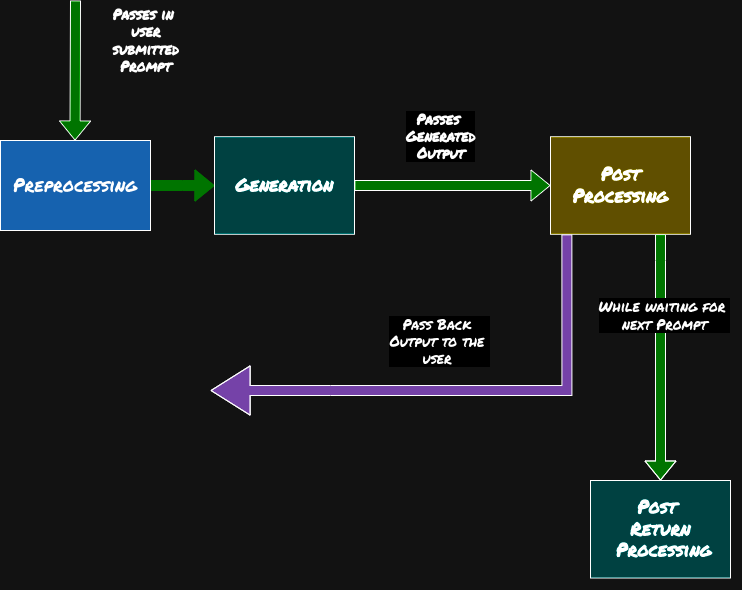
Diagram showing the complete LLM processing lifecycle:
- Preprocessing: Takes user-submitted prompt, prepares context and state
- Generation: LLM produces the narrative output
- Post Processing: Validates and formats the generated content
- Post Return Processing: Handles the response while waiting for next prompt, with feedback loop passing output back to user
Key Insights:
- Preprocessing phase prepares deterministic state before LLM sees it
- Generation is isolated - LLM doesn’t decide logic, only narrates
- Post-processing validates output meets format/content requirements
- Feedback loop allows continuous refinement while maintaining state consistency
This diagram became a reference point for both ReallmCraft and influenced ChatBot RPG’s architecture, demonstrating the consensus around separating programmatic control (pre/post) from generative narration (generation phase).
State Management Strategies
Defining “State”
The discussion revealed multiple interpretations:
Simple Interpretation (User-vali98):
“Your current Stats and debuff values in numeric form”
Broader Interpretation (User-50h100a):
- Statblocks (automatically updated)
- Physical state
- Mental state
- Geographic state
- Item state
- Relationship state
The "Sudden Door" Problem
How do you handle when players or LLMs introduce new elements not in the state?
User-50h100a’s insight: “sudden door” requires exhaustive scene description, which would be 500+ tokens and the model would go off rails.
Compromise: Start with constrained state (statblocks, core elements) and expand carefully.
Handling Environment State
Two competing approaches emerged:
Top-Down Generation:
World → Continent → Nation → Province → City → Building → Room
- Better for story-driven games
- Allows coherent theme management
- More upfront work
Bottom-Up Generation:
Current Room → Building → City (generate as needed)
- More flexible
- Just-In-Time generation
- Can lead to narrative inconsistency
User-veritasr’s Hybrid Solution (Feb 2024):
“Theoretically if I did it in a deterministic fashion, then it could literally be mapped. But… whether or not it’s actually worth doing it in a deterministic fashion or just having loose entries that are related to one another without any sort of overarching heirarchy…”
Result: Entry-based system where
entry nis connected toentry ywithout rigid hierarchy
The Prolog Experiment
User-irovos’s Insight:
“I liked the whole idea behind using prolog. Because its already linguistic Ramgirl(has_erection)” “you can literally feed it raw prolog and it can interpret it”
This led to explorations of linguistic programming approaches that LLMs could parse naturally while remaining programmatically enforceable.
Event-Driven Architecture
Event System Design
User-vali98’s Initial Event Structure:
type Event {
   prompt: string,
   statModifier: Function,
   option: Array<Options>,
}

type Option {
  statModifier: Function,
  NextEvent: Dict<Event, chance>
}Critique: This is essentially a state machine, which proved too limiting.
Better Approach (emerged later):
- Events trigger based on conditions
- Events modify state deterministically
- LLM describes the resolved event
- No user-facing “options” (free-form input instead)
Idempotence and Determinism
User-irovos’s Principle:
“a system like this should be idempodent… not model bound”
Meaning: The same input should always produce the same state change, regardless of which LLM is used. The LLM’s job is narration, not decision-making.
Data-Driven Design Philosophy
The “Just a Dataset” Realization
“Again, sounds like a dataset problem… train a model to update a state based off a current and parsed update”
Community Response: While theoretically possible, building a custom model was deemed impractical. Instead, focus shifted to:
- Structured data formats that any LLM can work with
- Prompt engineering to constrain behavior
- Programmatic enforcement of rules
Template Systems
The conversation repeatedly returned to templates as a solution:
- Templates for characters
- Templates for locations
- Templates for events
- Templates for items
This evolved into full modding frameworks in both major projects (ReallmCraft-Project, ChatBotRPG-Project).
Function Calling and Tool Use
Early Function-Like Keywords
User-50h100a’s Proposal:
FunctionRoll(Willpower, Target)
This predated widespread function-calling support in LLMs but pointed toward what would become standard practice.
The Control Problem
Core Design Principle
“Focus on constraining what the LLM ‘does’ rather than the user” - User-50h100a
The user doesn’t tend to manifest impossible things unless deliberately doing so. The LLM, however, will consistently introduce elements that break game logic.
Architecture Evolution Over Time
Phase 1: Pure LLM (Rejected)
Let LLM handle everything → Too unreliable
Phase 2: Hybrid Parsing
LLM output → Parse for state changes → Update state → Too error-prone
Phase 3: Constrained LLM (Consensus)
State changes determined programmatically → LLM narrates results → Reliable
Phase 4: Rule Engines (Later Development)
- Declarative rules
- Event-driven systems
- LLM as “decorator” (narration layer only)
Constraint Programming (July 2024)
User-veritasr’s Late-Stage Insight:
Shift from procedural logic to constraint-based:
Traditional: "Do these steps to reach result"

Constraint-Based:
1. These are possible solutions
2. These constraints make solutions unusable
3. Remove violating solutions
4. Project best solution forward
Function: Serves as “deduction” - eliminating impossibilities rather than constructing solutions.
Combined with:
- Rule engines (step-by-step induction)
- Utility systems (weighing pros/cons)
- Constraint solvers (eliminating impossibilities)
Emergent Behavior
“When you think of it that way, the three systems combined is actually pretty powerful… Interplay between all the systems basically promotes emergent behavior.” - User-veritasr
Key Architectural Patterns Identified
1. Separation of Concerns
- Logic Layer: Game rules, state management
- Narrative Layer: LLM text generation
- Data Layer: Templates, entities, relationships
2. Event-Driven Design
- Events triggered by conditions
- Events processed by rules
- Events narrated by LLM
3. Template-Based Generation
- Reusable schemas
- Parameterized content
- Modular expansion
4. Just-In-Time Generation
- Don’t generate everything upfront
- Create as needed
- Cache once created
5. Deterministic State, Probabilistic Narration
- State changes are predictable
- Narration can vary
- Same inputs → same game state
- Different narration each time
Lessons Learned
- LLMs are terrible at state management - Keep state programmatic
- Templates solve the content problem - Structured data > free generation
- Constraint the LLM, not the player - Users are more predictable than AI
- Separate actions from narration - What happens vs. how it’s described
- Modular architectures scale better - Plan for expansion and mods
Related Threads
- 02-Prompt-Engineering - Techniques for constraining LLMs
- 05-State-Management - State persistence patterns
- 08-NDL-Natural-Description-Language - Solution to narration problem
- User-veritasr - Primary architect
- User-50h100a - Early constraint philosophy
Related Enrichment Outputs
Pattern Library
- 00-PATTERN-INDEX - Complete architectural pattern library
- program-first-architecture - Backend-driven decision-making
- llm-processing-pipeline - Pre/Gen/Post processing phases
- separation-of-concerns - Logic/Narrative/Data layer split
- event-driven-design - Trigger-based game events
- ndl-bridge - NDL bridge pattern for narration
Prompt Library
- 00-PROMPT-INDEX - Complete prompt library
- narration-engine-system - Base narration system prompt
Quotes Worth Remembering
“Just use arbitrary xml tags” - User-giftedgummybee (the recurring “just” problem)
“then do so, man” - User-50h100a (response to “just” suggestions)
“Turns out that when you take away decision making from the LLM it behaves much better.” - User-veritasr
Action Items That Emerged
- Separate state management from LLM (consensus reached)
- Develop template systems for content (both projects implemented)
- Create rule/event systems (implemented differently in each project)
- Build modding frameworks (both projects achieved this)
- Industry-wide standard for LLM game state representation (still evolving)